Next Gen Electric Bikes: Latest Models, Future Tech & Top Picks
Take your riding to the next level with the latest generation of electric bicycles. Discover the best next-generation electric bikes available on the market and find the best model for your riding needs with our comprehensive comparison guide. From powerful fat tire models to lightweight, foldable commuter models, these are the latest and most advanced next-generation electric bikes available today.
Note: Our rankings are based on overall performance, value and rider feedback — not brand or price alone. A higher price does not necessarily mean a higher rank.
Disclaimer: Nextgenelectricbike.com is an independent review site and is not affiliated with any bike manufacturer. Brand names and models are trademarks of their respective owners. As an Amazon Associate, we earn from qualifying purchases.
Updated 18 Sep 2026, ⓘ Advertising Disclosure

TST Next-Gen Fat-Tire E-Bike (2000W, 28 MPH)
- 2000W peak motor with a 28 MPH top speed.
- 48V 15/25Ah battery, 20×4 fat tires and dual suspension.
- 7-speed gears with a clear LCD display.

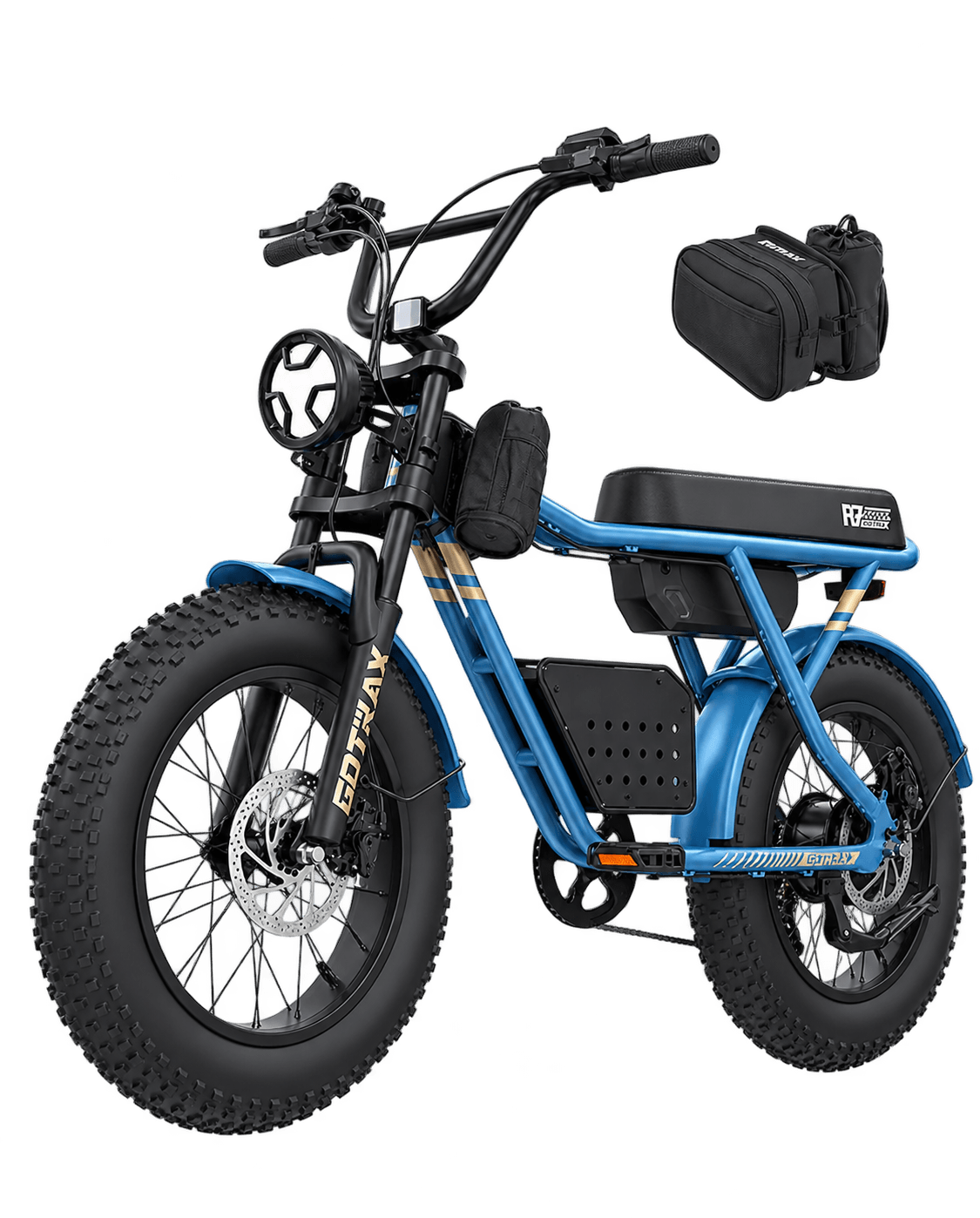
Gotrax R7 Fat-Tire E-Bike (Latest Generation)
- 750W peak motor with up to 45 miles of range.
- 20" fat tires, 25 MPH top speed, UL certified.
- Front suspension, padded seat, basket & frame bag.

Heybike Cityscape 2.0 (2nd-Gen Commuter)
- 1200W peak motor with a 468Wh removable battery.
- Up to 50 miles of range with 7-speed gearing.
- UL-certified 26" commuter build.

Jasion RetroVolt Pro All-Terrain E-Bike (Next Gen)
- 2000W peak motor, 30/38 MPH top speeds.
- 70/90-mile range on a removable battery.
- Hydraulic brakes and IPX6 all-terrain build.

Gotrax Dolphin Step-Thru E-Bike (New Generation)
- 500W peak motor with 30 miles of pedal-assist range.
- 7-speed with boost mode and 5 assist levels.
- Low step-thru frame with dual-disc brakes.

Aipas M1 Pro Step-Thru E-Bike (Next-Gen, UL 2849)
- 1800W peak motor with up to 85 miles of range.
- 48V 17.5Ah battery and dual suspension.
- Step-thru frame, SGS-certified to UL 2849.

ASKGO Next-Gen Electric Dirt Bike (2500W, NFC)
- 2500W peak motor, 28 MPH, 65-mile range.
- 48V 20Ah battery with 16"/20" fat tires.
- NFC keyless unlock for all-terrain riding.

Misodo Next-Gen Mountain E-Bike (1500W, 65 Mi)
- 1500W peak motor with up to 65 miles of range.
- 48V 10.4Ah removable battery and 7-speed gearing.
- 5 riding modes with front suspension.

LELEKUAI Folding Commuter E-Bike (Next Gen)
- 1200W peak motor, 20–28 MPH top speed.
- 32-mile range on a waterproof removable battery.
- Dual disc brakes, UL 2849 certified, folds flat.

Addmotor Cargo E-Bike (Next-Gen 750W Long-Tail)
- 750W GAROOTAN motor with a 48V 15Ah battery.
- Up to 75 miles of long-tail cargo range.
- Hydraulic brakes, UL 2849 certified family bike.
Never Miss an Ebike Deal!
Get the best daily discounts & price drops on next gen electric bikes straight to your inbox
What to Look for in a Next Gen Electric Bike
The following five key numbers are the key to choosing the best Nestgen electric bike: These include motor power, battery capacity, range, braking performance, and safety certification. If you choose them correctly then it will depend on your personal preferences. Here, I will explain each item in an easy-to-understand manner. As a real example, take the 10 bicycles compared above.
Motor power (watts)
This is the number that people should check first. However, there are some points that can be easily misunderstood. What the manufacturer describes is the “peak output”. This is the maximum output that the motor can exert for a short time and not the continuous output that the motor can continuously supply. In the USA federal regulations limit the continuous power of legal electric bicycles to 750W. The peak output of the 10 models selected this time ranges from 500W of the Gotrax Dolphin to ASKGO dirt bikes (2,500W). The average is about 1,420 watts. Electric bicycles of 500 to 750 watts are suitable for commuting on flat roads. The output of more than 1,500W is mainly useful for steep slopes, heavy riders, or for off-road driving.
Battery capacity (watt-hours)
First of all do not look only at the voltage and ampere hours. Multiply the voltage by the ampere-hour to watt-hours. This number is an indicator that properly predicts the mileage. The TST is equipped with a 48V 15Ah battery pack and has a capacity of 720Wh. The Aipas M1 Pro comes with a 48V 17.5Ah battery pack with 840Wh capacity. The ASKGO comes with a 48V 20Ah battery pack with a capacity of 960Wh. Heybike Cityscape 2.0 is listed as 468Wh. Actual driving typically consumes 15-25Wh per mile. A 720Wh battery can run between 30 and 48 miles, depending on the intensity of the drive.
Range (miles)
The range published for this group varies from 30 miles for the Gotrax Dolphin to 90 miles for the Jasion RetroVolt Pro. You must know that higher the number the better the case. This is the value when the pedal assist is set to the minimum. If you drive on the throttle only then that number can be reduced by about half.
Brakes and suspension
The Jasion and Addmotor are equipped with hydraulic disk brakes. They provide more powerful and stable braking force. In addition compared to mechanical disk brakes, it requires less force when brakes applied. This is especially important for high-speed and heavy bikes. The front suspension also helps to relieve the irregularities of the city road surface. The TST, Aipas and Jasion are equipped with dual or full suspension. This feature is useful for fat tires and off-road driving.
Certification
And one other thing that always be sure to check the UL 2849 certification mark. This proves that the entire electrical system including motors, controllers, wiring, and chargers is safe from fire and electrical hazards. We recommend you to also check that the battery pack has the UL 2271 certification mark. Some of the electric bicycles presented here are UL 2849 or equivalent SGS certified. This includes Aipas M1 Pro, ASKGO, LELEKUAI, Addmotor, etc. As of September 2026, California requires all electric bicycles sold in the state to have a certified battery and charger. The certification is no longer just an added value and it is becoming a prerequisite for purchase.
Next Gen E-Bike Features & U.S. Class Rules Explained
The technology packed into a modern e-bike is what earns it the next generation label. Here is what the key features actually do. These are also the legal rules that decide where you can ride.
Peak vs sustained power and torque
A 2,000W peak motor accelerates harder from a stop. It also climbs better. But it draws more power from the battery. As you know that torque is measured in newton-metres. This is what you feel on hills. Higher-wattage hub motors like the ASKGO 2,500W unit and the TST 2,000W unit deliver stronger low-speed pull. A 500W city motor feels weaker in comparison.
Throttle vs pedal-assist, and riding modes
The Pedal-assist adds power while you pedal. A throttle drives the bike with no pedalling at all. The best next gen bikes offer several modes. The Misodo runs five modes. These are pedal-only, PAS, throttle, cruise, and walk-assist. You can trade speed for range as needed.
Removable batteries, displays and smart unlock
The every top pick here uses a removable battery. You can charge it indoors. You can also lock the pack against theft. An LCD display shows speed, battery level, assist level and trip distance. The ASKGO adds NFC keyless unlock. You tap to start with no key. This is a genuine next-generation feature. The Jasion adds an IPX6 water-resistance rating. This helps in wet-weather riding.
Safety certification
UL 2849 covers the whole e-bike electrical system. UL 2271 covers the lithium battery pack. It protects against overcharge, short circuit, and thermal runaway. These are the certifications that insurers, campuses, and a growing number of states now first of all check it.
The U.S. three-class system
This decides where you can legally ride.
Class 1: Pedal-assist only. The motor cuts out at 20 mph. It is allowed almost anywhere a normal bike is allowed.
Class 2: Throttle and pedal-assist. It is capped at 20 mph. It is allowed in bike lanes and on roads. Some trails have limits.
Class 3: Pedal-assist only. It goes up to 28 mph. It is focused on roads and bike lanes. It is often barred from pedestrian paths. Many states require a helmet and a minimum age of 16.
Under federal law, a legal electric bicycle’s continuous power is limited to 750W and its assist speed is limited to 28 mph. In addition, some of the bikes that are compared this time claim peak output of 1,500 to 2,500 W. The maximum speed is listed as 28-38 mph. Jasion is listed as 38 mph. In the case of such a number the bike may deviate from the three standard classification frames. In that case then it may be treated as a moped or off-road vehicle that needs to be registered. It is recommendated to be sure to check the rules of your state or region. The high-power models should drive on private land or off-road, which is the right place.
E-Bike Categories & Who They're For
The ten bikes above split into four clear categories. Matching the category to your riding is more important than chasing the biggest wattage.
Fat-tire and off-road
These include a 2,000W TST ($569.99), a 2,500W ASKGO dirt bike ($539.99), and a 2,000W Jasion RetroVolt Pro ($989.99). The 4-inch fat tires and high peak power and it is ideal for driving on trails, sandy, snowy and gravel roads. It is heavy and consumes a lot of battery, but it demonstrates stable driving performance even outside of paved roads.
Commuter and step-thru
Among them are the $494.98 Gotrax Dolphin, the $594.14 Heybike Cityscape 2.0, the $898.99 Aipas M1 Pro, and the $309.98 Misodo Mountain electric bike. With low-floor frames, comfortable geometry and a range of 30-85 miles, these models are ideal for everyday urban driving and business travel. The Aipas is a premium option. It has an 840Wh battery and a range of up to 85 miles.
Folding
This is LELEKUAI and it is priced at $139.99. It adopts a 14-inch folding frame and can be stored in a closet, car trunk, under a desk, etc. With prices well below $150, it is the most affordable option to start an electric bike in the area. It is aimed at commuters in flat urban areas and last miles who value portability over power.
Cargo
This is the Addmotor long-tail at $1,199.00. It is the most expensive bike in the group. It is built to carry a passenger or heavy loads. It has a 750W motor, hydraulic brakes, and up to 75 miles of range. This is the family-hauler and grocery-run option.
Understanding real-world range
The most frustrating thing for new e-bike buyers is that they don’t reach their nominal range. This figure was almost always measured in the lowest pedal assist mode. It is also measured on a flat road surface with a light rider riding on it. The actual range varies greatly depending on the situation. In this case you can take advantage of the watt-hour (Wh) formula above. Try dividing the battery wh by about 15-25 wh per mile. Even with a 720Wh battery pack touted as a maximum of 60 miles, the actual mileage is realistic at around 30-48 miles under mixed driving conditions. There are a number of factors that can push the mileage down to the lower limit. This includes throttle-only use, sloping roads, weight of riders and payloads, lack of tire pressure, high-speed driving, headwinds, cold weather, etc. Lithium-ion batteries can reduce their range by 10-20% when the temperature drops to near freezing. Alwyas make a plan based on the numerical value that matches your driving conditions and not on the promotional statement. If range is your top priority then we recommend that you purchase a larger watt-hour capacity battery than you think you need.
E-Bike Test Results: What the Numbers Show
Put the ten bikes side by side and the spread in the specs tells you exactly where each one sits. Here is what the numbers reveal.
Motor power runs from 500W on the Gotrax Dolphin to 2,500W on the ASKGO peak. The average sits at about 1,420W across the group. The price runs from $139.99 on the LELEKUAI to $1,199.00 on the Addmotor. The average is roughly $655. Range runs from 30 miles on the Gotrax Dolphin to 90 miles on the Jasion. Battery capacity runs from 468Wh on the Heybike to 960Wh on the ASKGO among models with a stated capacity. Top speed runs from 20 mph on the Gotrax Dolphin to 38 mph on the Jasion. Ratings run from 3.7 on the Jasion to 4.4 on the Heybike and Aipas. The average is 4.13 across a combined 1,654 verified ratings.
Best power-per-dollar
The ASKGO stands out on raw output. It offers 2,500W peak for $539.99. That works out to about 4.6 watts of peak power per dollar. It delivers the most muscle for the money in this group. It also includes NFC unlock and a 65-mile range.
Best budget-to-range
The Misodo delivers up to 65 miles and a 1,500W peak motor for just $309.98. This is the strongest range-per-dollar here. It is the reason it sells 400-plus units a month even though it is a newer listing.
Longest range
The Jasion RetroVolt Pro reaches 90 miles. The Aipas M1 Pro reaches 85 miles with an 840Wh battery. These two lead on distance. The Jasion carries the most power-hungry spec. It also holds the lowest rating in the group at 3.7 from 34 reviews. Its numbers look best on paper. Treat that gap between spec and satisfaction as a caution.
Cheapest entry
The LELEKUAI folding bike at $139.99 is by far the lowest-cost way onto an e-bike here. It trades power and range for portability and price.
Most proven
If we analyze by review volume, the TST has 349 ratings at 4.2. The Heybike Cityscape 2.0 has 345 ratings at 4.4. The Aipas M1 Pro has 295 ratings at 4.4. These three have the deepest track records. The two 4.4-star bikes, Heybike and Aipas, combine the highest satisfaction with large sample sizes. This is why they rank so strongly on trust even though neither has the biggest motor.
Sales momentum
The TST moves 1,000-plus units a month. The LELEKUAI moves about 500-plus. The Misodo moves 400-plus. This is a useful real-world signal of which bikes buyers are actually choosing right now. The Addmotor cargo bike is the one model without ratings yet. That is why it sits last despite premium hardware. It is the highest-risk, newest-arrival pick.
Integrity & Reliability: How We Score These Bikes
The rankings above are not driven by price or brand name. Each bike mentioned above is weighed on a blend of measurable performance and verified owner feedback. A well-proven mid-range model can and does outrank a more powerful bike with thinner or weaker reviews.
What we weigh
We calculate the motor power and torque and both of these matter. The battery capacity in watt-hours matters. And also real-world range matters. Braking quality matters also supported with hydraulic scoring above mechanical. Suspension matters. Safety certification matters, covering UL 2849 and UL 2271. These make up the hardware side. On the evidence side we weigh the average customer rating. We also weigh the number of ratings behind it. Recent sales volume serves as a signal of live demand.
Why sample size matters
A 4.4-star rating from 295 reviews of Aipas is much more convincing evidence than a 3.7-star rating from 34 reviews of Jasion. It is also more persuasive than Addmotor which has no single review and only has a spec sheet. We intentionally value the ratings of hundreds of certified buyers. A small number of reviews can be distorted by a few good or bad experiences. That is why Heybike Cityscape 2.0 and Aipas M1 Pro have a reputation for reliability. Both models have maintained 4.4 stars with a rating of 295 to 345. Bicycles with high specs and low reputation are not appreciated, but rather lowered reputation.
Independence and updates
We are an independent review site. No manufacturer sponsorship influences the order. Prices, discounts, and ratings move constantly. This comparison is reviewed and refreshed as new models launch and figures change. When two bikes are close the one with stronger verified feedback and safety certification wins the higher spot.
Evidence & Sources
The performance figures in this comparison come from published manufacturer specifications. The satisfaction figures come from verified customer reviews on Amazon. These total 1,654 combined ratings across the ten bikes at the time of the last update. Motor, battery, range, and speed numbers are quoted as rated by each maker. Remember that peak wattage and top-mode range are best-case figures. Real-world results depend on rider weight, terrain, temperature, and riding mode.
Speed and power limits, and the Class 1, 2, and 3 definitions used above, reflect the standard U.S. three-class e-bike framework. Class 1 and 2 are assisted to 20 mph. Class 3 is assisted to 28 mph. The federal continuous cap is 750W. These also reflect the UL 2849 and UL 2271 safety standards. State and local rules vary and change. California began requiring certified batteries and chargers in January 2026. Confirm the current rules where you ride.
Prices, discounts, and availability are set by Amazon. They can change at any time. Always confirm the live price and full specification on the product page before buying. As an Amazon Associate, we earn from qualifying purchases. This comes at no extra cost to you.